

[adinserter block=”2″]
Ellena Duchow, a NICU and postpartum nurse from Seattle, shares two very different birth experiences that both required her to reconsider her original plans. From a birth center transfer during her first pregnancy to a last-minute change in home birth providers during her second, Ellena’s story explores what it means to feel informed and supported when circumstances change.
Her first birth involved preeclampsia concerns, Pitocin augmentation, an epidural-free vaginal delivery, and a challenging postpartum period that included tongue and lip ties and her newborn son’s hospitalization for a UTI and sepsis. During her second pregnancy, Ellena navigated perinatal anxiety, white coat hypertension, recommendations for induction, and multiple changes in care before experiencing an unexpectedly fast home birth.
Ellena reflects on the importance of collaborative care, trusting relationships with providers, and finding confidence in difficult decisions. Her stories offer encouragement to anyone navigating a change in birth plans or hoping for a positive birth experience after a stressful pregnancy.
First Pregnancy: Appendicitis and Planning a Birth Center Delivery
Ellena and her husband, Teddy, conceived their first baby after three cycles of trying, and she planned to deliver at a freestanding birth center with out-of-hospital midwives. At 11 weeks pregnant, she unexpectedly developed appendicitis and underwent laparoscopic surgery under general anesthesia, with reassuring checks on her baby before and after the procedure.
First Birth: Preeclampsia Concerns and a Hospital Transfer
Near 40 weeks, Ellena’s increasing urine protein-to-creatinine ratio and elevated blood pressure readings led her midwives to recommend transferring care to a hospital. Although she grieved the loss of her planned birth center experience, she found comfort in a compassionate hospital team that respected her birth preferences and welcomed her doula’s support.
Pitocin, Positioning, and an Epidural-Free Delivery
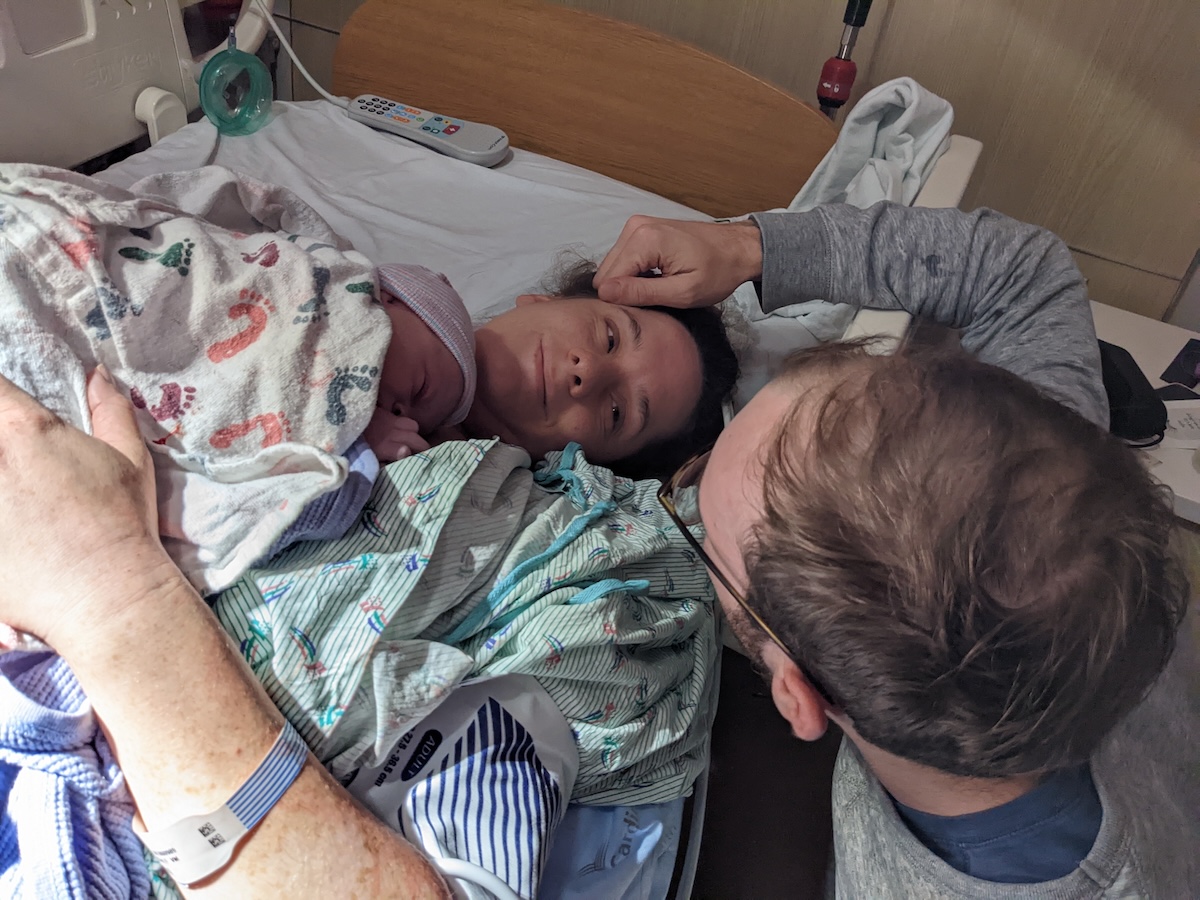
Ellena labored overnight before starting low-dose Pitocin when her contractions slowed, using Gilligan’s Guide, a peanut ball, counterpressure, and other positioning techniques to help her slightly asynclitic baby descend. After a long labor, she experienced an intense involuntary urge to push and caught her son, Basil Theodore, herself after approximately 30 minutes of pushing, without an epidural.
First Postpartum: Feeding Challenges and a NICU Hospitalization
Ellena experienced elevated postpartum blood pressure that required labetalol, along with a second-degree tear and a difficult breastfeeding journey caused by Basil’s severe tongue and lip ties. After a revision at five days old and approximately two months of triple feeding, Basil eventually breastfed successfully, but at four weeks old he developed a UTI that progressed to sepsis and required a week-long hospitalization with breathing support.
Second Pregnancy: White Coat Hypertension and Changing Birth Plans
During her second pregnancy, Ellena experienced significant anxiety surrounding blood pressure checks, even though her home readings and preeclampsia labs remained reassuring. Her original home birth midwives discontinued her care at 36 weeks, and after establishing care with hospital midwives, she ultimately chose another home birth midwife at nearly 39 weeks while continuing to consider her options.
A Precipitous Home Birth and Healing Postpartum
At 41 weeks and one day, Ellena had a Cook catheter placed to encourage cervical dilation, followed by contractions that quickly intensified at home. Her water broke at approximately 4:30 p.m., her midwife arrived minutes later, and Magdalena Helen, affectionately called Maggie, was born at 4:43 p.m. after an intense, rapid labor.
Ellena describes her daughter’s birth as an empowering and healing experience after an emotionally difficult pregnancy. Her postpartum recovery was smoother the second time, with easier breastfeeding, no recurring blood pressure concerns, and the joy of introducing Basil to his baby sister.
Ellena Duchow lives in Seattle, Washington, with her husband of six years, Teddy, and their two children, Basil (4) and Maggie (1). Their family is Orthodox Christian and enjoys walking, biking, cross-country skiing, and camping together.
Ellena works part-time as a NICU and postpartum nurse and enjoys knitting and sewing in her free time. She has been a longtime listener of The Birth Hour and loves connecting with other families about pregnancy, birth, and postpartum experiences.
Ellena welcomes messages from The Birth Hour community and enjoys connecting with others about birth experiences, midwifery care, and postpartum life. Instagram: @lenaellena
Birth Education & Research
- Evidence Based Birth — A resource offering research-based information about pregnancy and childbirth that Ellena frequently used when preparing for her first birth.
- Why Not Home? Documentary — A documentary exploring why some healthcare professionals choose home birth for their own families and the considerations involved in out-of-hospital birth.
- Gilligan’s Guide — A maternal positioning approach developed by Ann Gilligan that Ellena and her doula used to encourage optimal fetal positioning during labor.
Products & Postpartum Recovery
- Earth Mama Perineal Balm — A postpartum perineal care product Ellena appreciated during recovery from her second-degree tears.
Apps & Tools
- Miscarriage Odds Reassurer — An online tool that presents miscarriage probability estimates in a reassuring format, which Ellena found comforting during early pregnancy anxiety.
Birth Preparation
Cozy Earth biggest sale of the year ends December 3rd. Head to cozyearth.com and use code BIRTHHOUR for 35% off home and sleepwear. That’s cozyearth.com, code BIRTHHOUR. And when they ask at checkout where you heard about them, let them know The Birth Hour sent you.
A: Ellena transferred from her planned birth center to a hospital near 40 weeks after elevated blood pressure readings and concerning changes in her preeclampsia labs. With supportive hospital midwives, her doula, and low-dose Pitocin, she had an epidural-free vaginal birth and caught her son herself.
A: During her second pregnancy, Ellena experienced elevated blood pressure readings at prenatal appointments, even though her home readings and preeclampsia labs remained normal. The discrepancy, along with significant anxiety during office checks, led her original home birth midwives to discontinue care at 36 weeks, prompting her to explore other options with hospital and home birth providers.
A: Ellena’s water broke at approximately 4:30 p.m., and her daughter Maggie was born at 4:43 p.m., just 13 minutes later. Her midwife arrived around 4:35 p.m., and Ellena delivered while standing in a squat near the foot of her bed.
A: When Basil developed a fever at four weeks old, Ellena and Teddy brought him to the emergency department, where doctors discovered a urinary tract infection that progressed rapidly to sepsis. He required breathing support and a week-long hospitalization, and the family later learned that congenital hydronephrosis had contributed to the infection.
The Birth Hour is a birth story podcast hosted by Bryn Huntpalmer. With over 1,000 episodes and 27 million downloads, it is one of the longest-running pregnancy and birth podcasts in the world. New episodes publish every week — unmedicated, epidural, home birth, hospital birth, C-section, VBAC, and everything in between.
🎧 Listen: Search “The Birth Hour” where ever you get your podcasts.
📚 Course: thebirthhour.com/course
💛 Patreon: patreon.com/birthhour
[adinserter block=”2″]
Credit : Source Post