

[adinserter block=”2″]
As a labor and delivery nurse in Portland, Oregon, Bryn McNie had spent years helping other families welcome their babies, but experiencing childbirth herself brought an entirely new perspective. After planning an unmedicated birth in her hospital’s low-intervention midwifery suite, a preeclampsia diagnosis at 40 weeks changed her plans.
Bryn shares how elevated blood pressure led to an induction with misoprostol, magnesium sulfate for seizure prevention, and ultimately an epidural to help manage the intensity of labor. She also discusses how an unexpected epidural disconnection changed her pushing experience, the challenges of turning off her nurse brain during delivery, and navigating dysphoric milk ejection reflex (D-MER) while breastfeeding postpartum.
Her story offers a unique perspective on the difference between supporting birth professionally and experiencing it firsthand. It’s an encouraging reminder that birth plans can change while still making room for informed choices, support, and meaningful moments.
BIRTH STORY SUMMARY
Pregnancy and Planning for an Unmedicated Birth
Bryn and her husband, Connor, began trying to conceive in 2024 after previously using the Fertility Awareness Method to prevent pregnancy. Although conception took longer than they hoped, Bryn went on to have a largely uncomplicated pregnancy and received care from the certified nurse-midwives at the hospital where she worked.
She hoped to give birth without medication in one of the hospital’s special midwifery suites, designed to support low-intervention labor. Because eligibility depended on remaining low-risk, Bryn became increasingly anxious about her blood pressure and the possibility of needing an induction.
Preeclampsia Diagnosis and Induction
Around 39 weeks, Bryn’s blood pressure began trending upward, and by her 40-week appointment, it was officially elevated. Lab results raised concerns for preeclampsia, and her midwifery team recommended induction.
Bryn received one dose of misoprostol to begin cervical ripening and was started on magnesium sulfate to help prevent eclamptic seizures. Her water broke shortly after the medication, and labor quickly intensified.
Epidural and Active Labor
Between increasingly strong contractions and the uncomfortable side effects of magnesium, Bryn began experiencing sensory overload and decided to get an epidural. With pain relief and frequent position changes, she progressed to 10 centimeters and began pushing.
Despite regularly coaching patients through labor, Bryn found it surprisingly difficult to follow her own professional advice. Without a strong urge to push, she struggled to feel like she was making progress.
An Unexpected Epidural Disconnection and Delivery
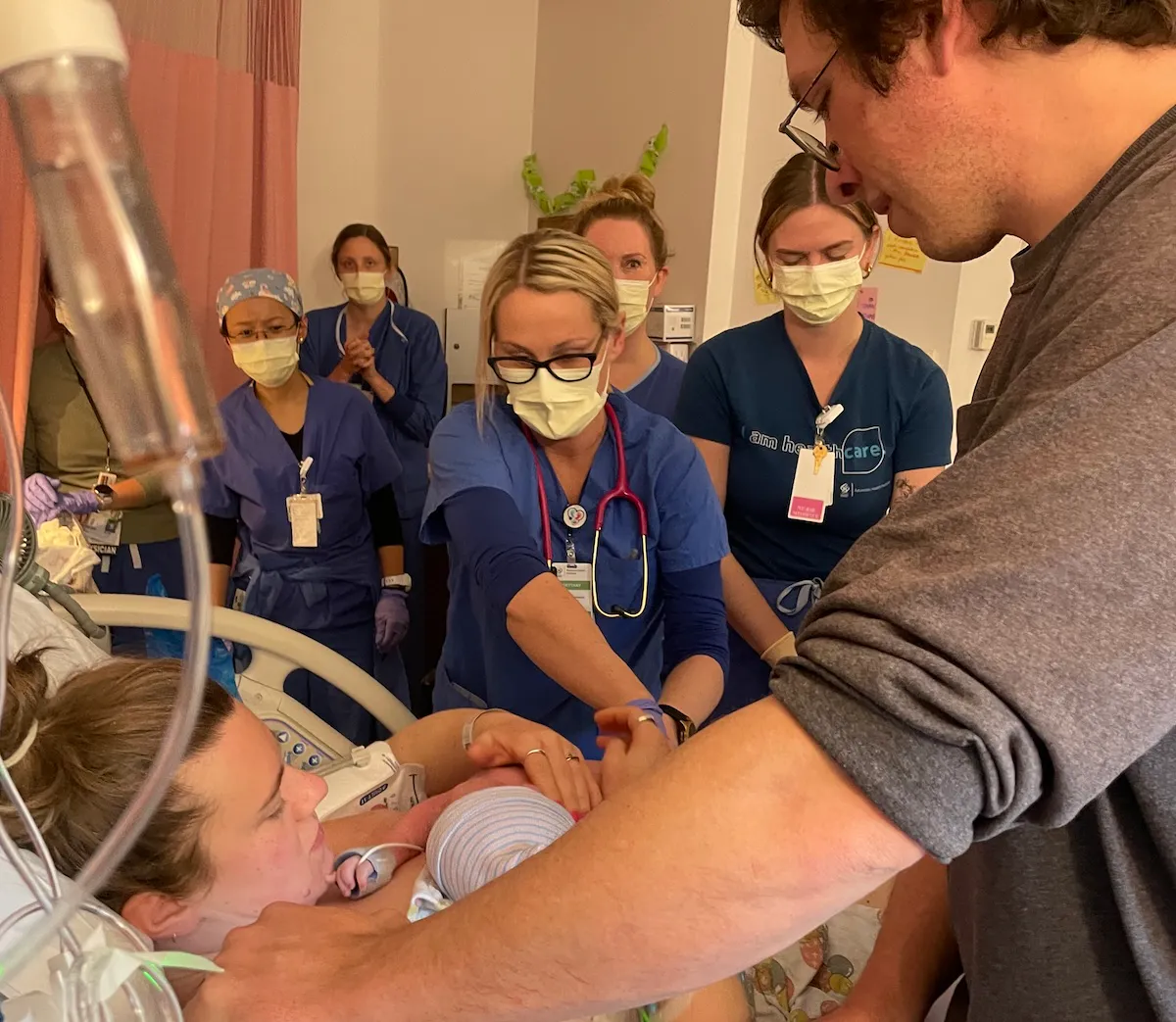
During pushing, Bryn’s epidural unexpectedly became disconnected, and as the medication wore off, she began experiencing sensations consistent with the fetal ejection reflex. With a much stronger urge to push, she felt her efforts becoming more effective and delivered her baby boy shortly afterward.
Even during delivery, Bryn found herself thinking like a nurse and worrying about whether her baby would need resuscitation. Her son needed minimal breathing assistance and some additional monitoring but was ultimately healthy, and Bryn experienced minor labial tearing that required a few stitches.
Postpartum and Breastfeeding
Bryn’s postpartum recovery went smoothly, and her larger-than-expected baby boy took to breastfeeding well. Despite worrying about painful latch and tongue ties based on experiences she had heard about, nursing was a positive experience overall.
She did experience dysphoric milk ejection reflex (D-MER), which caused unpleasant emotional sensations associated with milk letdown during the first several months of breastfeeding. By five months postpartum, those symptoms had essentially disappeared.
ABOUT BRYN
Bryn McNie is a labor and delivery nurse living in Portland, Oregon, with her husband, Connor, their son, and two cats. Her experience supporting birthing families professionally shaped her expectations for childbirth and gave her a unique perspective on navigating her own induction, delivery, and postpartum journey. Find her on IG at @BryB___
RESOURCES MENTIONED
- Taking Charge of Your Fertility by Toni Weschler — A comprehensive guide to understanding menstrual cycles, tracking fertility signs, and using the Fertility Awareness Method to prevent or achieve pregnancy.
- Ina May’s Guide to Childbirth by Ina May Gaskin — A collection of birth stories and childbirth education focused on understanding physiological birth and building confidence in the birthing process.
- Fertility Awareness Project — An Instagram-based fertility awareness education resource offering classes on tracking menstrual cycles and understanding fertility signs. [BRYN: add Instagram link]
- The Birth Hour — Birth stories featuring a wide range of experiences, including hospital births, home births, inductions, epidurals, cesareans, and unmedicated deliveries.
SPONSORS
Freestyle Diapers Head to freestyle.world/BIRTHHOUR and use code BIRTHHOUR to get 30% off your first 3 months of a Freestyle diaper subscription. That means you’ll pay just $49 a month for your first 3 months.
Airdoctorpro.com code BIRTHHOUR for up to $300 off!
FAQ
A: Bryn’s blood pressure began increasing around 39 weeks and was elevated at her 40-week appointment, prompting additional lab testing that raised concerns for preeclampsia. Her midwifery team recommended induction, and she received misoprostol to start labor along with magnesium sulfate to reduce the risk of eclamptic seizures.
A: During her induction, Bryn experienced uncomfortable side effects from magnesium sulfate alongside increasingly intense contractions, leaving her feeling overwhelmed and overstimulated. She ultimately chose an epidural, which helped her manage labor more comfortably while continuing treatment for preeclampsia.
A: Bryn’s epidural unexpectedly disconnected while she was pushing, and as the medication wore off, she began feeling a much stronger urge to push. She describes sensations resembling the fetal ejection reflex, which helped her feel more effective during pushing before delivering her son.
A: Bryn experienced D-MER during the first several months postpartum, despite breastfeeding otherwise going well. Her symptoms gradually improved and had essentially disappeared by five months postpartum, illustrating one possible course of this breastfeeding-related condition.
ABOUT THE BIRTH HOUR
The Birth Hour is a birth story podcast hosted by Bryn Huntpalmer. With over 1,000 episodes and 27 million downloads, it is one of the longest-running pregnancy and birth podcasts in the world. New episodes publish every week — unmedicated, epidural, home birth, hospital birth, C-section, VBAC, and everything in between.
🎧 Listen: Search “The Birth Hour” on Apple Podcasts or Spotify.
📚 Course: thebirthhour.com/course
💛 Patreon: patreon.com/birthhour
The Birth Hour Book
After more than a decade of sharing real birth stories on The Birth Hour, Bryn Huntpalmer brings those stories and lessons together in her new book, The Birth Hour: Real Birth Stories to Inform, Inspire, and Empower.
Featuring 41 real birth stories, the book explores a wide range of birth experiences and is designed to help readers feel more informed, prepared, and empowered as they approach birth. It includes a foreword by OB-GYN and All About Pregnancy & Birth podcast host Dr. Nicole Rankins.
The Birth Hour: Real Birth Stories to Inform, Inspire, and Empower is published by Penguin Random House and releases October 27, 2026. Click the link below to get $297 in pre-order bonuses!
[adinserter block=”2″]
Credit : Source Post